The Truth About S Corps: When They Work, When They Don’t, Should you elect for an S Corp?
Common S Corp Pitch
One of the most common things I see when reviewing IRS transcripts, audit files, and collection cases is this:
“My CPA told me to elect an S corp because it would save me taxes.”
In theory, that statement is not wrong.
In practice, it’s often incomplete, oversold, and sometimes damaging.
PRP Tax Law | Tax Representation firm, is a firm focused on tax controversy, audits, IRS investigations, collections, back tax filers, and cleanup jobs. I don’t sell entity formations, bookkeeping, payroll, or ongoing accounting packages. By the time someone gets to me, something has already gone wrong.
That vantage point matters.
Why S-Corps Are So Popular (On Paper)
The appeal of an S corporation is straightforward. When structured correctly, an S corp allows business income to be split between:
Reasonable compensation (subject to payroll taxes), and
Distributions (generally not subject to self-employment tax)
This is rooted in IRC §1366 and the exclusion of S-corp distributive income from self-employment tax under IRC §1402(a)(2).
At higher income levels generally when a business is netting around $150,000+ and grossing $250,000 to $300,000 or more this can create real tax savings. I don’t dispute that. I’ve seen it work.
But tax law doesn’t exist in a vacuum. Compliance matters, and that’s where the conversation usually breaks down.
The Part No One Explains Well Enough: Compliance Is Not Optional
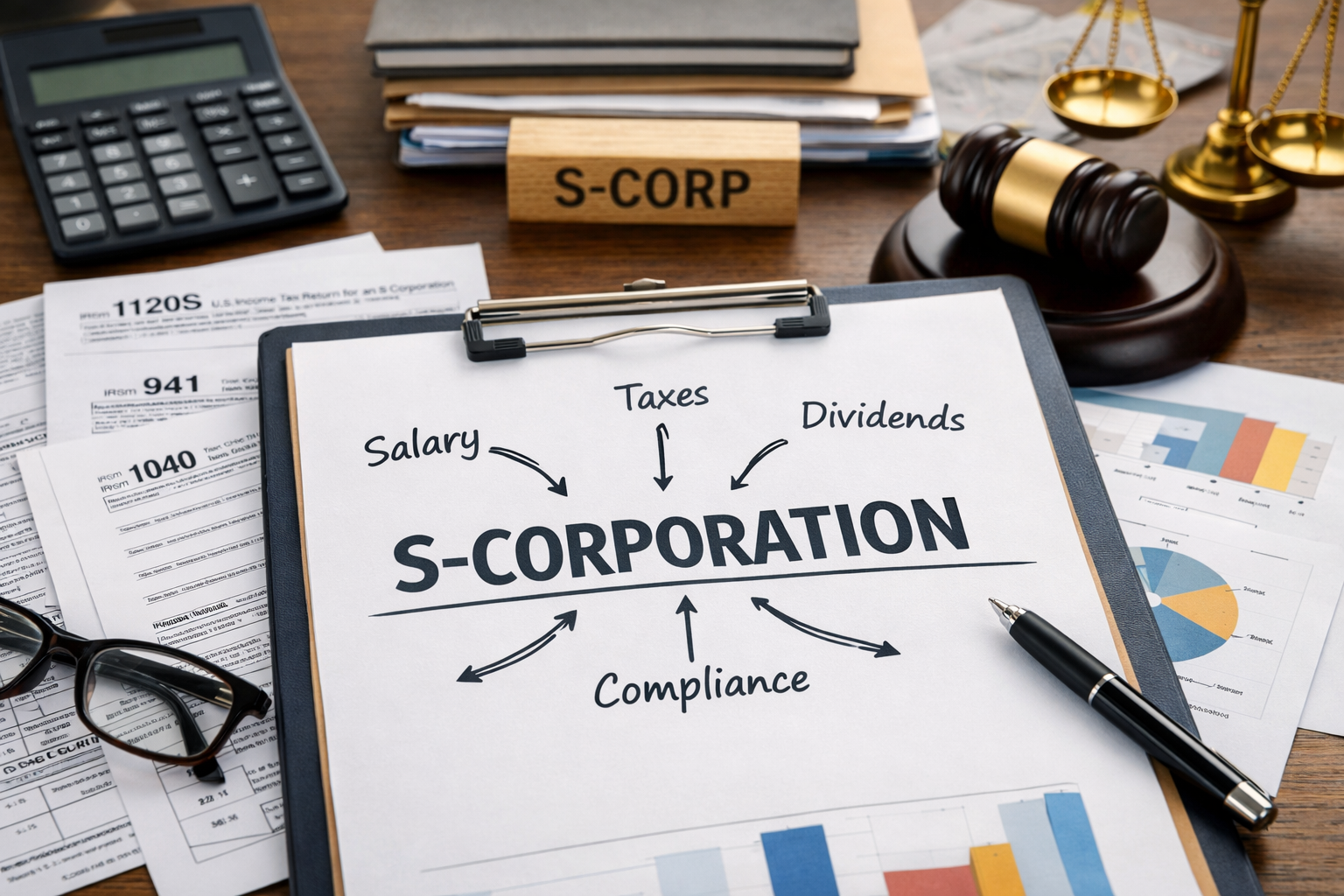
Electing S-corp status doesn’t just change how income is taxed, it fundamentally changes how a business must operate.
Once you elect S-status, you’ve triggered:
A corporate return filing requirement (Form 1120-S) under IRC §6037
Mandatory payroll for owner-employees
Quarterly employment tax filings (Forms 941)
Annual FUTA filings (Form 940)
W-2 and W-3 reporting
Reasonable compensation scrutiny under IRC §3121(d)
Miss any of these, and the IRS penalty machine turns on.
Failure to file an S-corp return alone can trigger penalties under IRC §6699. Miss payroll deposits and now you’re dealing with failure to deposit penalties and potentially trust fund recovery penalties under IRC §6672.
These aren’t theoretical risks. These are the cases that land on my desk.
The $7,000–$10,000 “Tax Savings” Mirage
Here’s what I see all the time:
A taxpayer is told they’ll save $7,000 to $10,000 a year by electing S corp status. What they weren’t told or didn’t fully understand, is the cost of upkeep:
Payroll services
Monthly bookkeeping
Corporate tax return preparation
Ongoing compliance monitoring
Advisory fees to “stay in good standing”
In many cases, the professional fees eat up most or all of the tax savings. Meanwhile, the taxpayer now has a more complex structure that is far more expensive to fix if neglected. Again, S Corps has its ups but again its not for certain taxpayers who dont take payroll, book keeping, tax planning, and compliance seriously.
From my side of the fence, the math often doesn’t justify the risk.
Single-Member S-Corps: Where I See the Most Damage
Single owner service businesses are where S corps most often break down.
Why?
Income is inconsistent
Payroll gets skipped when cash flow tightens
Owners don’t treat themselves like employees
Compliance slips because life happens
Many of these taxpayers didn’t realize:
They had to be on payroll even if they’re the only owner
They had to file employment returns even during slow months
They couldn’t “just catch it up later” without penalties
Years later, they come to me saying:
“I haven’t filed in years, and now the IRS says I owe penalties I don’t understand.”
When I pull transcripts, it’s clear the issue wasn’t the tax rate it was the structure.
Why My Perspective Is Different
I don’t need to sell you an S corp.
I don’t need to keep you on monthly bookkeeping.
I don’t benefit from pushing payroll services or entity elections.
I deal with the aftermath.
I see what happens when taxpayers are sold structures they don’t fully understand, often because “S corp” was the easiest answer a CPA or tax planner could give. It’s a basic solution, and sometimes there are more creative, simpler, and lower-risk ways to reduce taxes that don’t involve changing your entire business framework.
When an S corp is neglected, it is far harder and more expensive to clean up than a Schedule C.
So, Are S-Corps Bad? No. Are They Overused? Absolutely.
In theory, yes an S corporation can save you taxes.
But entity selection is prescriptive, not one size fits all. Just like medicine, it depends on your exact facts, income stability, compliance discipline, and willingness to maintain the structure properly.
If you want something you can “one and done” once a year, an S corp may not be the right fit. If you don’t want ongoing monitoring, payroll filings, and additional compliance layers, you need to think carefully before electing one.
The problem isn’t the S corp itself.
The problem is treating it like a universal solution.
And from where I sit deep in audits, collections, penalties, and cleanup that mistake shows up far too often.